Powered By Blogger
Showing posts with label vintage quilts. Show all posts

Sunday, March 18, 2012

When Old Quilts Get Together...

It was a perfect Spring day to air vintage quilts, and a perfect opportunity to share them with all who enjoy legacy quilts like these. Three of us Ocala-area quilters pooled our collections of antique quilts and put on a show to benefit Horse Protection Association of Florida and Humane Society of Marion County.

The venue was Harvest Village in McIntosh, Florida. It's an old citrus packing house and depot that now houses shops, small museum, a restaurant, and an ice cream store. The owner made space available to us, and we got into the show in a big way.

Some among our collections are just quilt tops, and these were perfect for hanging outside under protection of the porch roof. You can get a glimpse of the Dresden Plate and Spider Web behind and beside this lively Glorified Nine Patch (also called Improved Nine Patch).

I'm not sure of the name of this quilt pattern, but it's certainly vibrant despite it's age. I just call it "Big Red" until I locate the real name. How do you like the "ghost" block at the lower left?

This is the oldest quilt in our display, dating from circa late 1800s. It's in wonderful shape and makes use of the popular double-pink fabric of the era sawtooth border, and the LeMoyne Star block pattern.

And this is the treasure among all of the old quilts. It's a Marie Webster Basket design and was made around 1936. The hand applique is admirable, but the hand quilting is truly exquisite in this piece. Jill, one of our collectors, was fortunate to find this quilt at an estate sale. And Debra, the third collector, found its companion "Daisy Wreath" (shown below) at the same estate sale. The Daisy Wreath shows the same fine quilting and needle skills.

Lots of Stars were out today also. This scrappy Touching Stars was right next to the colorful Lone Star quilt. What a great pleasure to talk quilts all day with people who came from near and far to see and appreciate these old beauties! So many of the visitors enjoyed the show asked if we would have another, but we shared all the quilts we have in this one big event. Maybe we need to get out there and scout up some more? Hope you enjoy this bit of quilt heritage on National Quilting Day.

Friday, February 3, 2012

More Treasures from the Cardboard Box...


Isn't this a happy quilt top? It's another one from the treasure box quilting friend Claudia received from a family member. Those plaids and shirting stripes look right at home in this Glorified Nine Patch top (also called Improved Nine Patch). Notice how the yellow fabric in the melon pieces changes color... the quilter used two different yellows to complete her quilt top. Both lively and bright, one is a bit firmer weave than the other.

Here's where the rest of that yellow went... right into this Double Wedding Ring top. Studying the fabics in old quilts offers endless fascination in my book. I think these two tops are on Claudia's list to finish, along with the red Grandmother's Flower Garden shown here.

And I did some research to learn the names of these blocks, also shown in the earlier post. The closest names I can match up are these: top row, left- A Diamond Field, or variation of it; top row, right- Eccentric Star, also called Dutch Rose; middle row, left- Caesars Crown, also called Whirling Wheel; middle row, right- Ladies' Fancy; and bottom row- Star of LeMoyne, or 8-Point Star. The Enclyclopedia of Pieced Quilt Patterns by Barbara Brackman is the source I used to find the blocks. What a wonderful resource for quilters! All of the blocks are catergorized by type, and the search is guided one to ensure that it's easy to find a block among the thousands that are documented as to design and source. I'd like to try making a replica of each of the blocks.... except for Eccentric Star. That one is just too much for me!


I'm trying an experiment... post-dated publication of a blog post. If all goes well, you'll be reading this on the blog starting on Thursday, at which time I should be attending a quilt show in Nassau, Bahamas! Fourteen quilting friends are off on a 5-day cruise from the Port of Jacksonville on the Carnival Fascination with stops in Key West and Nassau. We plan to spend the at-sea days learning some new quilting techniques... hand work only, since there are crafting guidelines and limitations on what can be brought on board in the way of sewing tools.

Monday, January 23, 2012

Treasure Trove in a Cardboard Box...

This vibrant Grandmother's Flower Garden quilt top was among the pieces packed into a box and overlooked by family members when settling an estate. When it was eventually discovered, one of the family gave the box to her cousin, my quilting friend, Claudia. And Claudia brought the box to our quilting group for us to see and enjoy! To have the opportunity to pore over old quilts and blocks like these is such a treat. Nearly everything in the box (all uncompleted projects) was hand-pieced, which is a study in itself. But examining the fabrics and wondering about the quilter's fabric choices provided endless and enjoyable discussion. We all agreed that this quiltmaker had a sylish color sense. Her quilt tops were bright and happy.

Look at this GFG unit and the use of the check and plaid with the small floral print at the center of the flower. Some of the units were consistent in the use of matching fabrics in each successive ring of hexagons. You can see several more units that "match" in the photo above.

But there are just as many units that are random and more haphazard incorporated into the quilt top. I count 14 fabrics used in the hexagons at right. And there's that same pink floral at the center. I like the quiltmaker's "no rhyme or reason" approach to combining the pieces for her quilt. It adds to the carefree, make-do feel. Plus the choice of red for the "path" between units is unique. I'm not sure I've seen it used, or at least if I have, it's been infrequent.

Also inside the box were stacks and stacks of pieced blocks, many with a complex pattern like the ones below. The little LeMoyne Star blocks at the very bottom of the photo are only 5" or 6" square.


I plan to do some research to find the names of the other blocks. Most look familiar, but I can't quite come up with the names. However, the block with the four fan units in the corners... that's a new one to me. I don't think I've seen it used in a quilt before. Very pretty, and it just shows how versatile pieced units like fans can be... they can stand alone in Fan blocks, become Wheels or Plates, or form a different block design like this one. I have a copy of Barbara Brackman's Encyclopedia of Pieced Quilt Patterns that I haven't cracked open in awhile. I'll let you know what I learn, and will show more of these  tops and blocks in upcoming posts. What a delightful box of treasures!

Sunday, October 16, 2011

Pieces of the Past...


Vintage quilts and blocks hold a big appeal for me. And occasionally the appeal is in the multi-generational nature of a project. Case in point: this Sunbonnet Sue quilt, brought to our recent quilt retreat by guild member Marietta. Her mother made the appliqued and embroidered blocks in the late 1930s. As a child, Marietta was allowed to embroider on some of them. However, the blocks were set aside, unassembled, for quite some time. Marietta kept them with her through a number of moves, and eventually unearthed them in the 1990s to set the blocks together in a quilt. She even found the old pattern flyer with which the blocks were made! What a treasure.


Sunbonnet Sue is engaged in different activities in the blocks... playing with her doll, tossing a ball, and carrying her school books. I love these expressive blocks, and am happy Marietta has preserved them in a piece that will now be a legacy in her family.


I like to "rescue" old quilt blocks, too. This small piece is one I made using a block that probably dates from the late 1800s or early 1900s. With the period reproduction print fabrics that became widely available in the 1990s, I was able to set the old block into a new piece. I even love old blocks that are badly made! Just look at the wavy lines in the patchwork... endearing. And I'm a bit of an expert at making my own wavy lines in patchwork, too!

Sunday, October 2, 2011

Swooning With the Oldies...


Despite all the quilts and "quilty things" I get up to, there is nothing that makes my heart skip a beat like a vintage quilt. Appreciation for old quilts is what got me started in quilting to begin with. And I had the opportunity to spend quality time with a number of old quilts, and the women who also love them, when I attended the quarterly meeting of the Florida Quilt Study Group. Calendar conflicts had kept me from attending for many months, so it was a real pleasure to rejoin the group.

Take for instance this stunning Ocean Waves quilt, brought by group member Jill. The sheer number of those tiny, tiny triangles fills me with admiration for the long-ago quiltmaker. Just look at all those prints! The amount of blue used in this quilt seemed to really set off the other colors and make them sparkle. And if this Ocean Waves whets your appetite, take a look at The Quilt Index to see more... Ocean Waves with Redwork, with dark background fabrics, in pastels, you name the variation and you'll find an example. The Quilt Index is a quilt documentation resource that provides information and images on quilts housed in museum collections as well as those held privately. Just type in the pattern of interest, and pages upon pages of references and images are yours for the browsing. Warning: you can spend a whole afternoon or more just wandering through the site! But it's so worth your time, and your many questions will get answers.


A quick and admiring glance at a beautiful antique like the vertical strippy (my absolute favorite setting) tied quilt, above, is one thing, but an up-close look truly provides a fascinating glimpse into history. The photo shows the backing folded over and lying on the quilt top. The quilt contains century-old fabrics, including mourning prints, ticking, and even the very early (late 1700s?) piece, shown at right. Well-known quilt appraiser Teddy Pruitt also attended the group, and offered lots of tid bits about these old quilts. That's right... not only is Teddy's profession old quilts, but she spends her recreational time with them, too. Good for her!

Below right is the backing full on (love those pieced backings!), and another photo of the quilt top. The block photo at center shows my nomination of a fabric to be included in a line of reproduction prints. That green with the amorphous blob is a print I'd use again and again. Well, I could go on and on, but you probably want to go spend some time at The Quilt Index and at Teddy's website. So much to see, so little time.


Tuesday, April 26, 2011

Oh, the Quilty Things You See...


Our weekly quilting and craft group meeting is always full of pleasant surprises. Last week was no exception. Deborah Johnston attened an estate auction and bought this scrappy pieced Star quilt. I can't recall, but I think the pattern is called Touching Stars. From the fabrics, I'm guessing it is early 1900s. The quilting is lovely... feather wreaths in the setting pieces, and a cable around the perimeter (detail photos below). Just one of the many fabrics used in this quilt has become fragile and shattered. And there is some staining. But it's a wonderful old quilt with a lightweight batting, so it drapes beautifully.


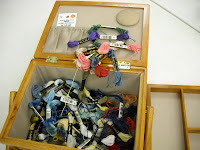
She also bought this sewing box. It required a bit of gluing to stabilize it, but it's now ready for use. The box was full of embroidery floss, which Deborah generously shared with group members.


And speaking of floss, one of our Nancy's (we have three!) bought this floss organizer at a tag sale for just a couple of dollars. It was filled with floss, meticulously organized using the DMC Floss numbering system. She gave it to another of our Nancy's who does a lot of embroidery. We all like flipping through this large floss book just to soak in the color!


And speaking of embroidery, Gwen is working on this sweet redwork project. She's used a large variety of prints in the geese that border the embroidered center. Yes, it was another good day at the Citra group.


Tuesday, August 24, 2010

Preserving History... AKA Other People's Stuff...


I've been the happy recipient of bits and pieces of other people's unfinished sewing projects over the years. Often I'm able to include them in my own work, and I like keeping bits of history alive that way. For instance, my friend Norma passed along lots of small pieced fan units that her mother had made. I love looking at the old fabrics, and estimate they are from the 1950s, take or give a decade. While sorting through these pieces, I found that I could group them roughly by color, join them, and come up with Dresden Plate units. So I'm working on the blocks, and will complete a quilt top with them... some day. It's going to be a lively, happy quilt.

I also received a shoe box full of accurately cut diamonds from which to piece a Tumbling Block quilt top. I admired how the quiltmaker had been so organized in cutting and storing these. They were grouped and carefully wrapped in packages containing multiple diamonds in light-medium-dark values. Aren't they pretty?


However, I also encountered a dilemma. The quilter had pieced two of the three diamonds together already, and even completed some of the Tumbling Block units. But she did not use the sewing technique for creating Y-seams, or set-in seams, to make flat-lying units. That of stopping and starting stitches 1/4" from the fabric edges. See that little pucker? Uh oh.


It looks nice and flat from the pressed wrong side. But peek under the seam. There's that little culprit!


The question now is how will I use these? To use all of them, I'd have to get the seam ripper out and unsew all of her pieced units. I don't even like unsewing my own mistakes! So that's pretty much out of the question.

But I think there are enough cut diamonds to piece some units, and I stitched a few, like the one below, to see how it went. They lie flat. So my current plan is to piece what I can and use them in a much smaller project than what the quilter planned on. I'll re-sort and re-group the usable diamonds and go from there.

But that's not all! A man brought his wheel-chair bound mother's needlework files to our local sewing group after she passed away. This woman was meticulous and I wish I'd met her. She had cross-stitch pieces that looked as good on the back as on the front. And look at her careful notes on quilt patterns. How could we possibly throw them out after all the work she put into them? So you can see why my sewing room needs the occasional overhaul and cleaning.

Saturday, March 20, 2010

And More Vintage Quilt Tops....


Awhile back in February, I showed you some vintage quilt tops that were given to my friend Mary. Those were just the ones in the top of the sack. There were still more quilts in that sack to ooh and aaah over.

But before looking at two more of the quilt tops, I wanted to note an interesting coincidence. After seeing the photo, several people mentioned to me that this Basket top (above, also shown in the earlier post) is like the Scrap Basket Quilt seen on the cover of the current issue American Patchwork and Quilting Magazine, a publication of Better Homes & Gardens. The baskets on the cover quilt are done in a yellow/gold print, but the layout and the Double-Flying Geese border are the same. The timing of seeing the old quilt top and the cover quilt in the same month is really something!

Well, here's the first of two more vintage tops. This scrappy quilt is made from the block pattern known as Mexican Star, according to Barbara Brackman's Encyclopedia of Pieced Quilt Patterns. Alternate names for the block include Mexican Rose and Panama Block. The Brackman book characterizes the block as a "Nine X". This means the blocks "have a diagonal orientation within the square", and that "the blocks are divided by diagonal seams to make 8 or 9 major shapes." This may be my favorite of the tops Mary was given. But then again, I may have already identified my favorite in the previous post. Suffice it to say that I just love all old quilts.

This quilt top is lively with plaid and striped shirting prints. The light-colored sashing between the blocks and rows adds nice contrast and quiets down what could be a "busy" quilt design, giving the eye a resting place between the blocks. The quiltmaker used dark blue and burgundy prints sparingly but effectively to create strong contrast within the blocks. This is a beauty, but sadly we don't have any history on it. It's a reminder to me about remembering to label quilts (and maybe even tops?). I know it's important, and I'm always curious about the story behind a quilt. But, sorry to say, I'm not 100% faithful at labeling my own.

Scrappy quilts are my favorites (there's that word again!), and this One-Patch is really appealing. It looks random and unplanned, but upon a closer look, you can see that the quiltmaker concentrated green print and blue squares toward the edges of the quilt top. It's subtle, but appears to be part of a plan.


I once heard a speaker on vintage textiles advise us to "treat old textiles like you'd treat your favorite grandmother... not too much heat, not too much light, handle gently with great care." Now that's good advice.